LeadX Ventures Blog
How to Research Venture Capital Firms Before Pitching
Choosing which venture capital firms to approach is an important part of preparing for a startup fundraising round.
A prominent VC brand might look attractive, but reputation alone does not make a firm the right investor for your company. You need to understand its investment thesis, preferred funding stages, sector focus, geographic reach, and portfolio.
Thorough venture capital research helps founders identify potential matches and prepare more relevant conversations.
Here is a practical framework for researching VC firms before pitching them.
1. Understand the Firm's Investment Thesis
An investment thesis describes the types of companies a venture capital firm seeks to back.
It may cover particular industries, technologies, business models, markets, stages, or long-term trends.
Start by reviewing the firm's official website, investment philosophy, portfolio, partner biographies, and published articles.
Look for answers to these questions:
- Which industries does the firm invest in?
- Does it invest at pre-seed, seed, Series A, or later stages?
- Which countries or regions does it cover?
- Does it prefer B2B, B2C, deep tech, or other business models?
- Does it publish any specific investment criteria?
- Are there particular themes or technologies the firm emphasizes?
Record the evidence and source links rather than relying on a short description from a third-party database.
2. Review the VC Firm's Portfolio
Portfolio research helps you understand the types of businesses a firm has backed.
Identify companies that resemble your startup in relevant ways, such as industry, customer segment, business model, technology, or stage at the time of investment.
For each relevant company, record:
- Company name and website
- Industry and business model
- Funding stage at investment, where known
- Investment date and round
- Publicly announced investors
- Why the company is relevant to your startup
Portfolio similarity can reveal a possible connection between your business and a firm's investment interests.
3. Research Recent Investment Activity
A firm's historical investments provide useful context, but recent activity may be more relevant when evaluating a potential fundraising target.
Search funding announcements, portfolio news, official company updates, and other credible sources.
Look for:
- Recently announced investments
- New funds or changes in investment strategy
- Investments at stages similar to yours
- Activity in your target geography
- New portfolio companies in your industry
Record the announcement date and distinguish between a completed investment, a reported transaction, and an unconfirmed claim.
A recent investment is evidence of activity, not proof that the firm is currently accepting pitches or has capital available for your round. Confirm current preferences directly where possible.
4. Understand Check Size and Funding Stage
One of the most important questions is whether a firm's investment preferences align with your fundraising requirements.
Research the firm's published stage preferences and check-size range, if available.
Consider the following:
- Does the firm invest in companies at your current stage?
- Is your target investment size within its stated range?
- Does it typically lead rounds or participate alongside other investors?
- Does it invest in your target country?
- Does its strategy support your business model?
If these details are unavailable, mark them as unknown rather than estimating with false precision.
The goal is to identify firms worth researching further, not to assume that every firm with a relevant portfolio is a viable target.
5. Identify the Relevant Partner
At many VC firms, individual partners focus on particular industries, company stages, or investment themes.
Once you identify a potentially relevant firm, investigate its team.
Review partner biographies, published articles, conference appearances, public professional profiles, and portfolio involvement.
Document:
- Partner or principal name
- Professional role
- Relevant sector experience
- Companies they have worked with or invested in
- Publicly stated investment interests
- Official contact or pitch submission route
Avoid assigning an investment mandate to a partner unless you can find supporting evidence.
If the firm has an official submission process, follow it. Where appropriate, consider a professional introduction through a founder, advisor, or other mutual connection.
6. Build a VC Research Scorecard
A simple scorecard can help you prioritize your research.
Consider a 100-point framework:
Check out our work sample
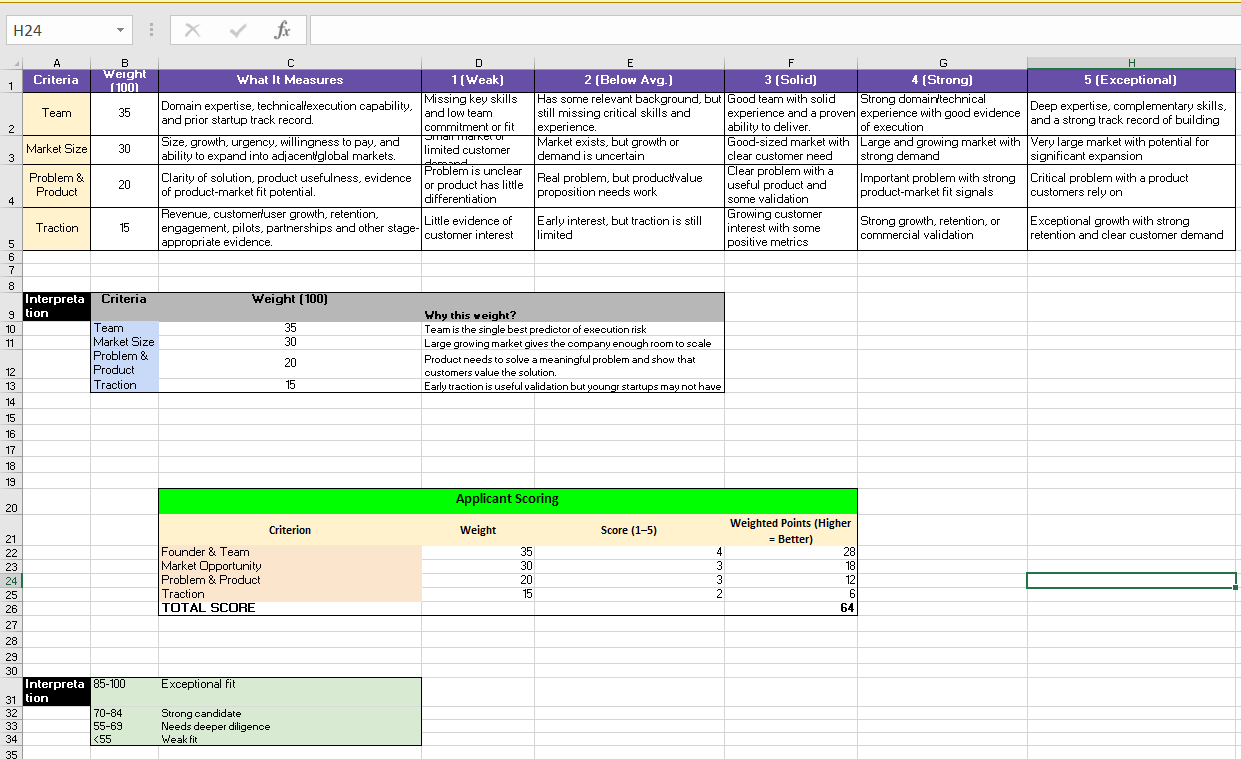
Score each criterion using documented evidence. If important information is missing, flag it for further research rather than automatically awarding points.
The scorecard is a prioritization aid, not a probability model for predicting whether a VC will invest.
7. Organize Your Findings in a Research Database
Store your findings in a spreadsheet, Google Sheets, Airtable, or an appropriate CRM.
Recommended fields include:
- VC firm and website
- Investment thesis
- Sector and stage preferences
- Geographic focus
- Published check-size range
- Relevant portfolio companies
- Recent investment announcements
- Relevant partner
- Official submission route
- Source links and verification dates
- Fit score and rationale
- Unanswered research questions
- Outreach status and next action
This creates a reusable research asset for your fundraising process.
It also makes it easier to revisit your shortlist when your fundraising target, market, or strategy changes.
8. Turn VC Research Into a Focused Fundraising Strategy
The purpose of venture capital research is not to contact every recognizable firm. It is to identify a set of investors whose stated interests and available evidence suggest a reasonable fit with your startup.
Prioritize the firms you can explain most clearly: why they are relevant, what evidence supports that assessment, and what you need to confirm before reaching out.
At LeadX Ventures, we help startup founders research venture capital firms and angel investors, evaluate investment criteria, and build curated investor databases tailored to their funding goals.
Looking for relevant VCs for your next funding round?
Explore LeadX Ventures to learn more about our startup investor research services.
Book Consultation